
 Email Sign Up
 Cart
Cart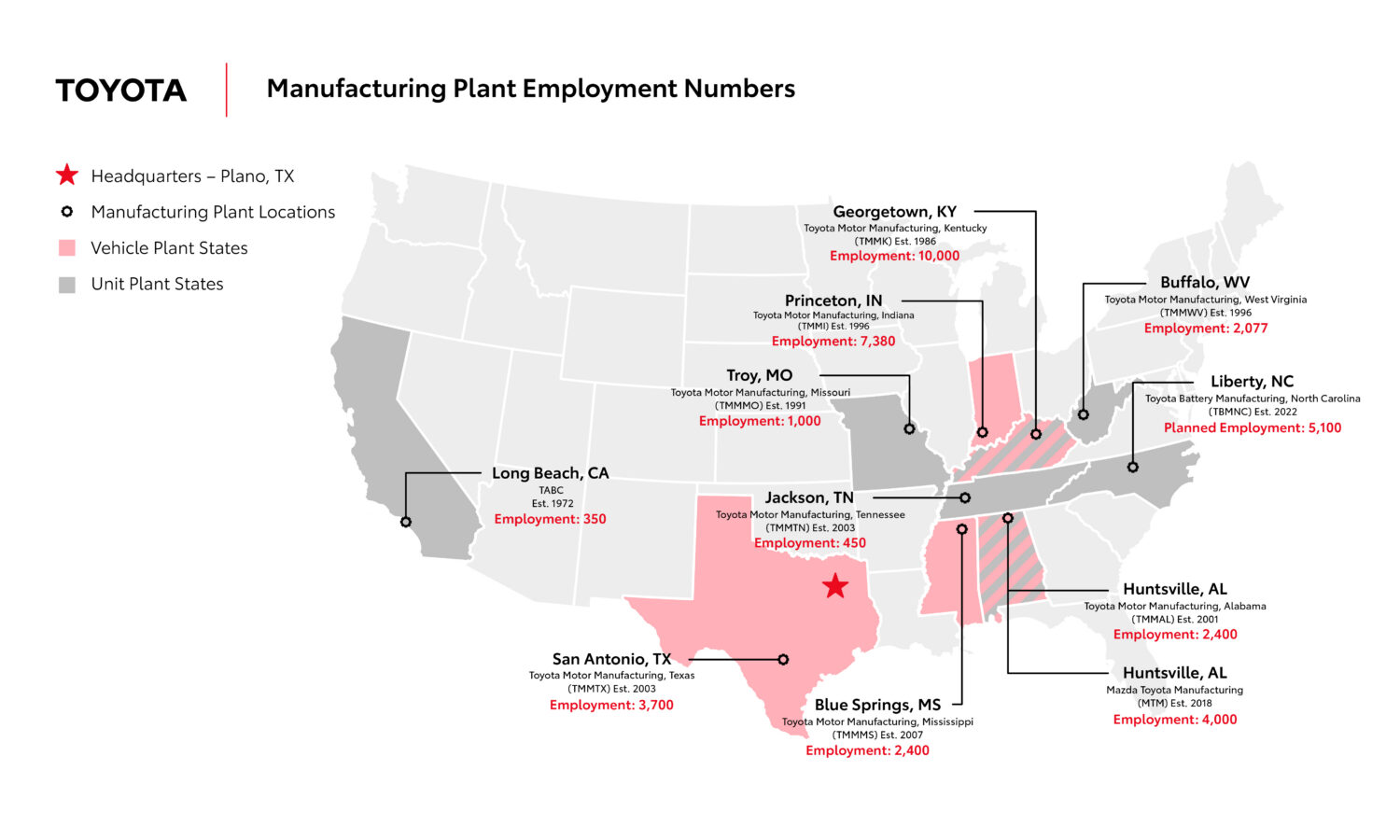
Toyota U.S. Manufacturing: A History of Local Production, a Future of Expansion
Read More Share on Facebook
 Share on Linkedin
 Send email
 Copy Link
Since 1988, when Corollas began rolling off the line in California, Toyota has pursued a strategy of assembling more and more of the vehicles it sells in the U.S. Nearly four decades later, the company continues to stay this course — committing to billions of dollars in future investment.
Toyota first began selling vehicles in the U.S. in 1958. Thirty years later, its first locally assembled vehicle — a Corolla — rolled off the line at New United Motor Manufacturing, a joint venture with General Motors in Fremont, California.
Where do we stand today, nearly four decades since that milestone?
The growth of the scale and impact of Toyota on automotive assembly in the U.S. has been nothing less than exponential. Yet, based on its track record of investment, it would also be true to say that the company is just getting started.
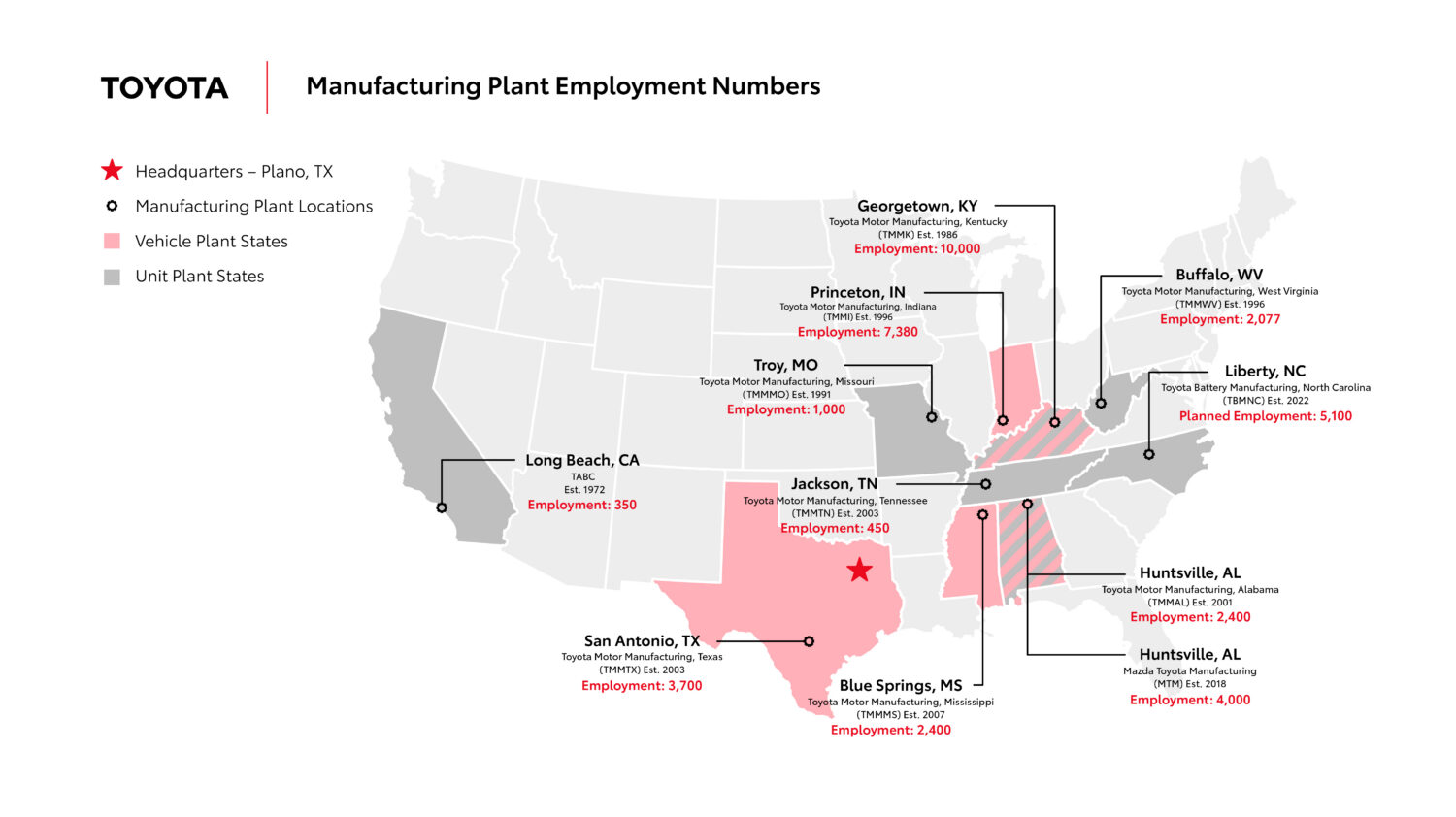
The adjoining map provides a current snapshot: more than 31,000 people employed at 11 manufacturing facilities in 10 states.
The largest of these plants is Toyota Kentucky. It is also Toyota’s first wholly owned U.S. manufacturing facility, assembling its first Camry in 1988. It is the largest of the 11 and, in fact, is the largest Toyota manufacturing plant in the world.
The newest? That would be Toyota North Carolina, which began assembling hybrid vehicle batteries at the end of 2025.
Here’s a plant-by-plant summary of their output:
- Toyota Alabama — Four-cylinder + HEV engines; 2.4L Turbo + HEV engines; Twin-turbo V6 + HEV engines; differentials
- Toyota Kentucky — Camry Hybrid, RAV4 Hybrid, 4-cylinder & V6 engines, hydrogen fuel cell kits, axles, steering components, machined blocks, cylinder heads, crankshafts, camshafts, rods and axle assemblies, and dies
- Toyota Indiana — Grand Highlander, Highlander, Highlander Hybrid, Lexus TX, Sienna Hybrid
- Toyota Missouri — Cylinder heads
- Toyota Mississippi — Corolla
- Toyota North Carolina — Lithium-ion batteries
- Toyota Tennessee — Engine blocks, automatic transmission cases and housings
- Toyota Texas — Tundra, Tundra HEV, Sequoia HEV, rear axles (begins fall 2026 for Tacoma, Tundra and Sequoia)
- Toyota West Virginia — TNGA 4-cylinder and 2.5 L engines, transmissions and hybrid transaxles
- Mazda Toyota Manufacturing — Corolla Cross
- TABC, Inc. — Body parts for Toyota Tacoma and service parts for all models
While this is all very impressive, the future of Toyota operations in the U.S. promises to be even more so. Since the start of 2024 through the end of 2025, the company announced plans to invest nearly $20 billion in these facilities, including $13.9 billion to establish Toyota North Carolina. And that was before making a further multi-year commitment of up to $10 billion in its U.S. operations tied to future mobility and electrification.
In other words, Toyota doesn’t just say that it supports the communities in which it does business, it backs it up with tangible action. As Toyota Motor North America Executive Vice President and COO Mark Templin declared at the recent Toyota National Dealer Meeting, “Our ultimate objective is to simply assemble more of what you and our customers want and need here in the U.S.”
Long may it continue.


Originally published October 2, 2026
 Add to Cart
 Print
Print Convert to PDF