Email Sign Up
 Cart

 Share on Facebook
 Share on Linkedin
 Send email
 Copy Link
SALINE, Mich. (Nov. 11, 2026) — Toyota offered a glimpse of what’s next in mobility and manufacturing at an event held this week at its North American R&D headquarters, where the company showcased a variety of technologies currently in development.
The advanced technologies highlighted can help shape how we move and how vehicles are built, and included topics and items related to:
- Automated Driving;
- Software Defined Vehicles;
- Artificial Intelligence and Robotics; and
- Next generation powertrains and batteries.
“Toyota’s next chapter of innovation builds on the expertise of our people, the strengths of our vehicles and manufacturing operations, and the knowledge and data we have accumulated through real-world experience,” said Hiroki Nakajima, Chief Technology Officer, Toyota Motor Corporation. “By bringing those strengths together with advances in AI, software and robotics, we aim to accelerate the development of smarter vehicles, more adaptable manufacturing and new mobility solutions that improve everyday life.”
The showcase highlighted five main areas from a global perspective:
1. Automated Driving and Toyota’s Real-World Data
To advance automated driving, Toyota is bringing together real-world driving data, insights from expert drivers and end-to-end AI developed in-house, along with safety guardrails. Toyota aims to introduce L2++ automated driving assistance technology in select retail vehicles beginning in 2028, with plans to expand availability to a wide range of models worldwide within several years. The company also shared how it is developing technology to connect vehicles, people and infrastructure to help make getting around more efficient.
2. Arene: A Software Platform for Mobility and Beyond
Arene, Toyota’s software platform, helps teams build and continuously improve vehicle software. Its tools and data capabilities let applications run across different types and generations of high-performance semiconductors, or system on a chip (SoC), helping software adapt as vehicle hardware evolves.
Toyota plans to expand Arene from the Toyota RAV4 and Lexus ES to approximately 50 models and 10 million vehicles worldwide by 2030 and aims to provide it to alliance partners. Toyota also sees possibilities for the software beyond vehicles, with potential uses in robotics, factories, infrastructure and homes.
3. Physical AI, Robotics and the Future of Manufacturing
Toyota is empowering its workforce by integrating physical AI and robotics onto the factory floor, further enhancing the Toyota Production System (TPS) and the expertise of some 18,000 Takumi, or highly skilled workers, worldwide. The approach starts with our team members simplifying processes through TPS, then identifying where the introduction of automation and robotics can serve as a tool to assist them in their tasks and improve ergonomics and efficiency.
Toyota is working toward three levels of factory automation (FA) designed to support our team members: conventional robots for predefined repetitive tasks (FA 1.0) to reduce physical strain, adding automation and synchronized end-to-end production and logistics (FA 2.0) to streamline workflows, and creating an environment where people and robots collaborate and work side-by-side (FA 3.0) to augment human capability. This gives physical AI and robotics a place to learn from our expert Takumi, improve through real-world use, and scale in the future to support our team members in increasingly complex roles.
Toyota and its suppliers expect to invest approximately JPY ¥1 trillion (~$6.3 billion USD) annually from 2028 onward to renew aging production equipment. That investment will support the deployment of approximately 150,000 robots across Toyota and Toyota Group companies and 250,000 at suppliers.
With the scale of Toyota’s manufacturing base, the company has a substantial opportunity to develop and validate robotics solutions that partner with our team members in sophisticated, demanding production environments, and support that with an integrated Factory Control Platform that connects equipment, logistics, and the supply chain. Beyond the initial deployments and demand, Toyota aspires to expand its robotics business to other manufacturers and, over time, to other industries.
4. Next-Generation Electrification
Toyota also showcased advances in hybrid and battery electric vehicle (BEV) systems, along with new battery technologies being developed to continue offering customers choices as part of its multi-pathway approach to mobility.
Next-generation hybrid technology aims to improve fuel efficiency for customers while giving vehicle designers more flexibility through more compact systems. A new prismatic lithium-ion battery design places terminals horizontally, helping deliver approximately 20% lower battery height and 20% higher efficiency.
Toyota also shared progress on all-solid-state batteries, targeting their introduction in a future model by the end of 2028. Compared with conventional batteries, solid-state batteries offer key benefits, including an ability to store more energy in less space with faster charging times, opening new possibilities for commercial vehicles, drones and electric vertical takeoff and landing (eVTOL) aircraft.
5. Technology Developed for North America – and Beyond
Through a tour and displays at its York campus, the program highlighted Toyota’s North American R&D’s role of advancing mobility within the region, while contributing to Toyota’s global engineering expertise. The campus showcase included brief tours of its safety center, where crash tests are conducted, its benchmarking center, a place where vehicles are disassembled and compared with Toyota’s own technology, and the Toyota Battery Center for evaluating batteries for hybrid, plug-in hybrid, hydrogen and full battery-electric vehicle powertrains that opened last month.
Scion by Toyota
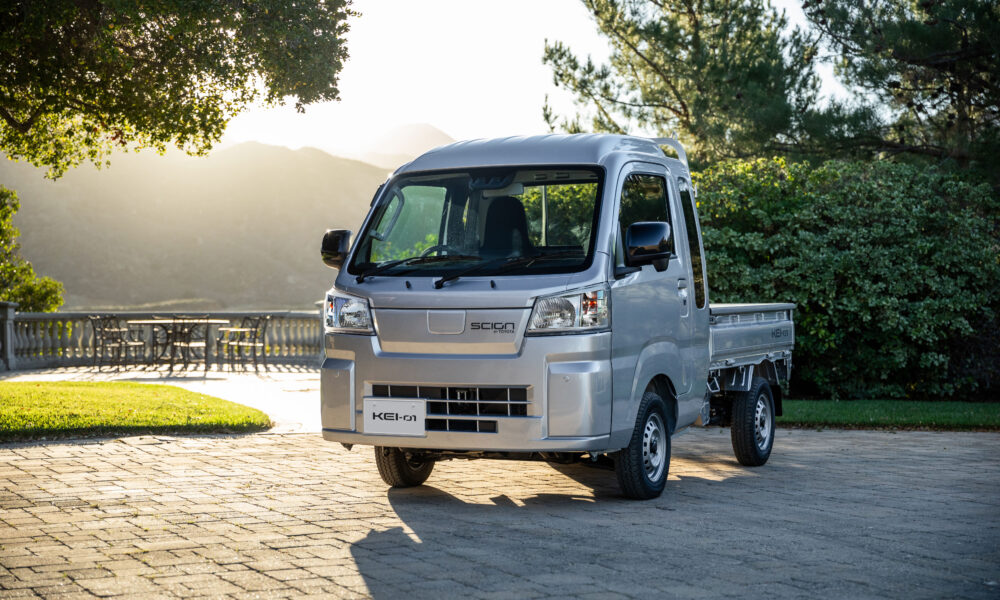
At the event, the company also introduced Scion by Toyota, a new brand built around curiosity, possibility and the freedom to explore mobility in new ways with purpose-built vehicles for the American market.
As the first manifestation of the Scion by Toyota vision, Toyota revealed the KEI-01, a U.S.-assembled ultra-compact, lightweight commercial truck. Certified as a FMVSS 500 or Low-Speed Vehicle (LSV), the KEI-01 is an affordable, highly capable and remarkably maneuverable utility vehicle that will be assembled at Toyota Motor Manufacturing Indiana.
Toyota also revealed two Scion by Toyota off-road concepts:
- The SXS Concept side-by-side reimagines the all-terrain vehicle for a new generation of outdoor enthusiasts. Developed by Toyota’s North American engineering team, SXS combines a high-output turbocharged four-cylinder hybrid powertrain producing more than 300 horsepower with a compact, purpose-built off-road package.
- The BKE Concept foldable electric 2-wheeler created around the challenge of making short-distance mobility easier, more useful and more seamlessly integrated into everyday life.
More information on Scion by Toyota can be found here.


TMNA R&D
For more than 50 years, Toyota’s Research & Development groups in North America have participated in engineering projects for several of the best-selling Toyota vehicles on U.S. roads. Teams are now creating both next-generation vehicles and new and advanced mobility concepts that can better move people, goods and information. Centered in Ann Arbor, Michigan, Toyota’s North American R&D groups are pursuing Toyota’s mission to “Produce Happiness for All” by making life safer, easier and more enjoyable.
Media Contacts
Dan Nied
Toyota Motor North America
Mobility Communications Manager
(310) 408-6381
[email protected]
 Add to Cart
 Print
 Convert to PDF

Related Images